

The UK’s long-awaited vape tax is here.
From 1 October 2026, Vaping Products Duty officially came into force, changing the economics of selling e-liquid in the UK virtually overnight.
The headline figure is £2.20 duty for every 10ml of vaping liquid.
But that doesn’t necessarily mean every bottle on the shelf suddenly jumped by £2.20 on Thursday morning.
There’s a transition period, old stock can still be sold and retailers now have a rather important date in March circled on the calendar.
So, what has actually changed – and what happens next?
How Much Is The New UK Vape Tax?
The new Vaping Products Duty is charged at a flat rate of 22p per ml, or £2.20 per 10ml.
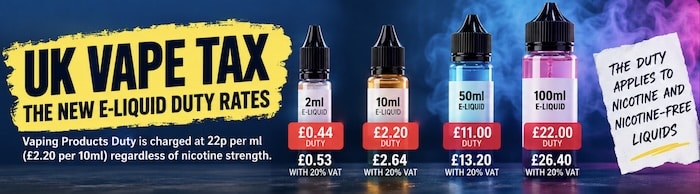 That works out as:
| Vaping Liquid | Vaping Products Duty |
|---|---|
| 2ml | £0.44 |
| 10ml | £2.20 |
| 50ml | £11.00 |
| 100ml | £22.00 |
And there’s no cheaper rate for nicotine-free liquid.
The duty applies to vaping liquids whether they contain nicotine or not. It can also apply where a liquid needs to be mixed with something else before it is vaped.
So yes, that includes the likes of zero-nicotine shortfills designed for vaping and the nic shots that usually accompany them.
HMRC confirms the £2.20-per-10ml rate in its Vaping Products Duty guidance.
Does That Mean Vape Prices Have Gone Up By £2.20?
Not necessarily.
The duty is charged within the supply chain. Manufacturers and importers are the businesses primarily responsible for accounting for it.
What happens to the final retail price is another matter.
HMRC has specifically said it is a commercial decision whether the cost is passed on to retailers and consumers.
Some businesses may absorb part of the increase. Realistically, many won’t have the margin to do so.
And there’s another reason prices may look a little all over the place for the next few months.
Old stock hasn’t suddenly become illegal.
Retailers Can Still Sell Existing Unstamped Stock
This is probably the part of the change most likely to cause confusion.
There is a six-month grace period running from 1 October 2026 until 31 March 2027.
Vaping products manufactured or imported before 1 October 2026 can continue to be sold without a duty stamp during that period.
Products manufactured or imported for the UK market from 1 October onwards are different. These fall under the new duty regime and, when required, must carry a vaping duty stamp before being released onto the market.
In practical terms, one vape shop might still have plenty of pre-October stock available at its old price, while another could already be receiving duty-paid replacement stock.
We could therefore see a staggered increase in prices rather than one huge overnight jump across the entire industry.
HMRC explains the transition in its guidance for vape retailers and wholesalers.
What’s The New Vape Duty Stamp?
Alongside the tax comes the Vaping Duty Stamps Scheme.
The stamps are attached to the outermost retail packaging and are designed to help identify products that have gone through the legitimate UK duty system.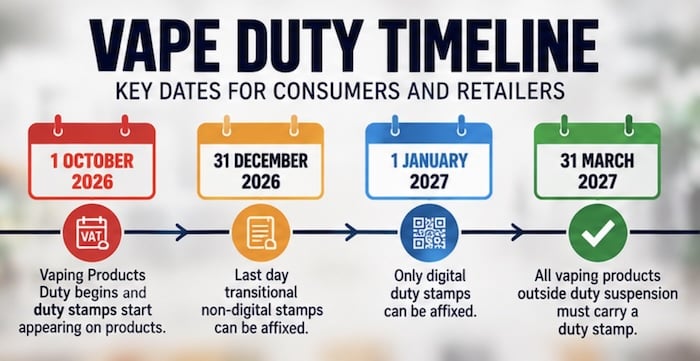
There are a few dates worth remembering:
- 1 October 2026: Vaping Products Duty begins and duty stamps start appearing on products.
- 31 December 2026: Last day transitional non-digital stamps can be affixed.
- 1 January 2027: Only digital duty stamps can be affixed.
- 1 April 2027: All vaping products outside duty suspension must carry a duty stamp.
The digital version includes a scannable code, with HMRC saying retailers and consumers will eventually be able to use the system to help check product authenticity.
More details can be found in HMRC’s Vaping Duty Stamps guidance.
What Changes For Vape Shops?
For ordinary vape retailers buying legitimate duty-paid products from their suppliers, there is at least some good news.
They don’t have to register to pay Vaping Products Duty or buy the stamps themselves simply because they sell vaping products.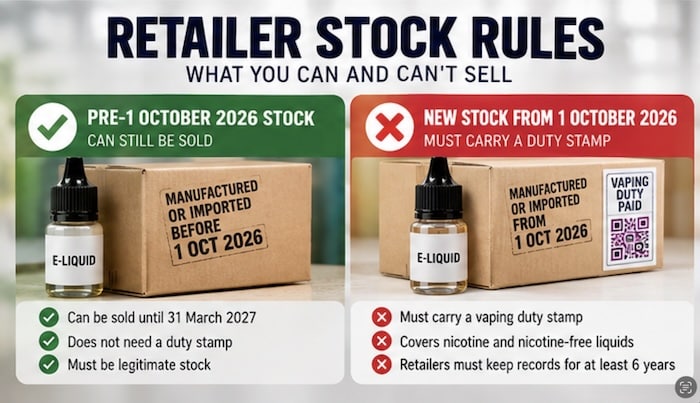
However, retailers do now need to pay much closer attention to where their stock comes from.
HMRC says businesses should check whether products have the required duty stamp, establish where the goods came from and retain normal commercial records such as invoices and delivery notes.
If unstamped stock is offered after 1 October, the retailer should have enough evidence to show why it can legally remain unstamped – for example, evidence that it was manufactured or imported before 1 October.
HMRC also tells businesses handling vaping products to keep relevant records for at least six years.
That makes buying cheap stock from a questionable supplier considerably more risky than it used to be.
31 March 2027 Is The Big Deadline
For retailers, this is arguably the date that matters most now.
Eligible old unstamped stock can continue to be sold until 31 March 2027.
From 1 April 2027, that grace period is over.
All vaping products being held outside an approved duty suspension arrangement must then carry the required duty stamp.
HMRC says remaining unstamped stock should have been sold, returned to the supplier, exported, destroyed or otherwise lawfully dealt with before that deadline.
Retailers continuing to hold or sell non-compliant products may face penalties, seizure of the goods and, in serious cases, criminal investigation.
What Does It Mean For Vapers?
For consumers, the biggest effect will almost certainly be price.
But don’t expect the change to look the same everywhere straight away.
A shop with several months of old stock could keep selling it under the grace period. Another business might move onto new duty-paid stock much faster.
The government’s own impact assessment estimates that around 5.1 million people who vape could be affected through higher prices, with heavier users naturally seeing the biggest financial impact.
The government says the tax is intended to reduce the affordability and appeal of vaping, particularly among young people and people who do not smoke.
At the same time, tobacco duties were increased from 1 October, with the government saying this was done to maintain the financial incentive for smokers to choose vaping over cigarettes.
You can read the government’s full Vaping Products Duty impact assessment here.
The EcigClick View
So this isn’t quite the “everything gets £2.20 more expensive overnight” moment some were expecting.
Not yet, anyway.
For the next six months we’re effectively going to have two generations of stock working their way through the same market – older products covered by the grace period and newly manufactured or imported products carrying the new duty.
That should make the next few months interesting for both prices and margins.
For retailers, though, the message is pretty simple: know where your stock came from, keep the paperwork and don’t get caught with a pile of unstamped products when April rolls around.
And for vapers?
Enjoy any old-stock prices while they last.
Because the £2.20-per-10ml tax is now very much real.
I’m sure this will do wonders to help smokers make the switch and curb that black market trade.
Sources
- HMRC – New Vaping Products Duty comes into effect
- HMRC – Handling wholesale or retail vaping products in the UK
- HMRC – How to pay Vaping Products Duty
- HMRC – How vaping duty stamps work
- HMRC – Introduction of Vaping Products Duty from 1 October 2026
- Finance Act 2026 – Vaping Products Duty legislation