
Europe’s plans to overhaul its vaping and tobacco laws have hit an unexpected obstacle, with reports suggesting new proposals could be pushed into 2027.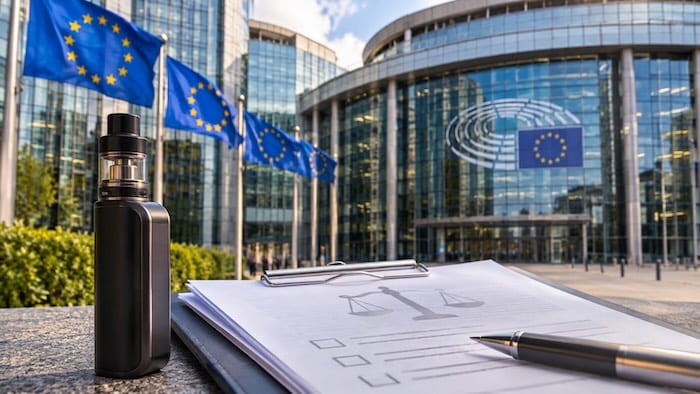
The development comes just days after the European Parliament voted overwhelmingly in favor of updating tobacco and nicotine legislation.
But while politicians are calling for tougher controls, the European Commission is reportedly struggling to get its regulatory proposals through its own assessment process.
For vapers, vape retailers, and manufacturers across Europe, that leaves plenty of questions about what happens next.
EU Tobacco Legislation Hits a Regulatory Roadblock
According to reports published in November, the European Commission’s Regulatory Scrutiny Board (RSB) issued a negative opinion on the impact assessment supporting proposed revisions to the Tobacco Products Directive (TPD) and Tobacco Advertising Directive (TAD).
The reported decision, dated November 9, represents a significant obstacle for the Commission’s planned reforms.
The RSB reviews the quality of evidence and analysis supporting major EU legislative proposals. Its role is to ensure that regulations are properly assessed before moving forward.
A negative opinion doesn’t automatically kill a proposal.
However, it can force officials to revisit their assessments and potentially delay the legislative process.
The Commission had reportedly been working toward presenting its proposals before the end of 2026.
That timetable now appears increasingly unlikely, although no formal postponement until 2027 has been confirmed.
European Parliament Wants Tougher Vape Restrictions
The setback comes at an interesting time.
On November 12, the European Parliament adopted a resolution on Europe’s Beating Cancer Plan by 447 votes to 66, with 91 abstentions.
Among its recommendations was a call for urgent revisions to existing tobacco legislation.
The resolution specifically identifies electronic cigarettes, heated tobacco products, nicotine pouches, and other emerging nicotine products as areas requiring updated rules.
Measures supported or proposed for consideration include:
- Restrictions on flavors that attract young consumers.
- Potential plain packaging requirements.
- Stronger health warnings and product information.
- Better age verification for online sales.
- Additional controls on advertising and promotion.
- Increased minimum excise duties on tobacco and nicotine products.
Importantly, these are recommendations within a parliamentary resolution, not new restrictions that have already become law.
The Commission must still develop legislative proposals before the normal EU legislative process can proceed.
What Could This Mean for Vape Flavors?
Flavors are likely to become one of the most closely watched issues.
Several European countries have already introduced their own restrictions on flavored vaping products, creating different rules across national markets.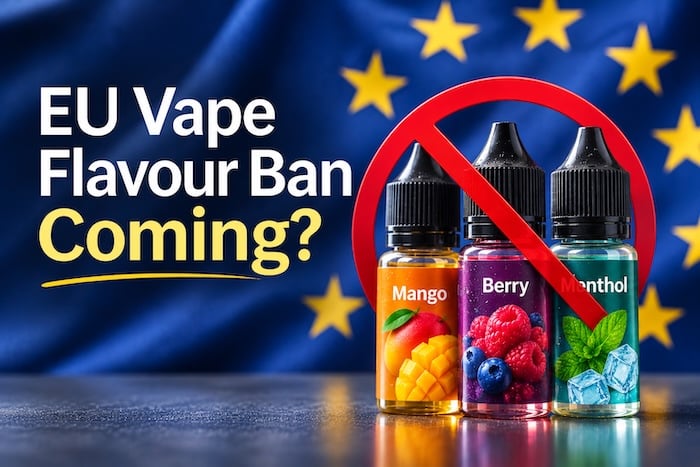
A revised Tobacco Products Directive could potentially introduce a more coordinated European approach.
Supporters of tougher flavor restrictions argue that sweet and fruit-flavored products can appeal to young people who have never smoked.
However, critics question whether broad restrictions could also discourage adult smokers from switching away from combustible cigarettes.
The Parliament’s resolution refers specifically to flavors that attract young consumers, rather than explicitly demanding a complete EU-wide flavor ban.
Exactly how any future legislation would define or restrict flavors remains unknown.
A Delay Doesn’t Mean the Proposals Are Dead
It’s worth distinguishing between a setback in Brussels and the abandonment of tobacco control reform.
The European Parliament has made its position clear: it wants updated legislation covering both traditional tobacco and newer nicotine products.
The Commission’s reported regulatory difficulties concern the evidence and assessments supporting the proposals.
That is a different issue from whether EU lawmakers ultimately support stricter regulation.
Any revised proposals would still have to navigate the European legislative process, including scrutiny and negotiations involving Parliament and member states.
Separate discussions about tobacco and nicotine taxation are also taking place and should not be confused with the TPD review.
What Happens Next?
The immediate question is whether the European Commission can resolve the reported concerns surrounding its impact assessment.
Until a formal legislative proposal is published, it is impossible to say exactly which vaping restrictions could be introduced, how they would operate, or when they might take effect.
For the vaping industry, the uncertainty is far from ideal.
Manufacturers and retailers need time to prepare for changes affecting product availability, packaging, and compliance.
Consumers, meanwhile, deserve clear information about which products will remain legally available.
There is also an important public health question.
Regulations designed to discourage young people from taking up nicotine need to account for adults who already smoke and may benefit from switching to less harmful alternatives.
Getting that balance right should be central to any future legislation.
For now, the message from Brussels is somewhat contradictory: lawmakers want faster action, but the Commission’s preparations appear to be slowing down.
Europe’s vaping rules may be heading for significant changes. The question is no longer simply what those changes will look like, but when they will arrive.
Sources
– [European Parliament – Adopted resolution on Europe’s Beating Cancer Plan, November 12, 2026](https://data.europarl.europa.eu/distribution/doc/TA-10-2026-0376_en.pdf)
– [Eunews – European Parliament approves Cancer Plan, November 12, 2026](https://www.eunews.it/en/2026/11/12/the-european-parliament-approves-the-cancer-plan-but-the-european-tobacco-reform-has-stalled-at-the-technical-review-stage/)
– [Tobacco Reporter – EU Commission Watchdog Rejects Tobacco Impact Assessment, November 13, 2026](https://tobaccoreporter.com/2026/11/13/eu-commission-watchdog-rejects-tobacco-impact-assessment/)