
As Brussels prepares to overhaul its tobacco and nicotine legislation, international experts are warning that excessively restrictive regulations could undermine smoking cessation efforts and drive more consumers toward the black market.
It’s a concern that deserves attention, particularly given research published earlier this year estimating that the EU’s commercial vape black market is already worth €4.8 billion.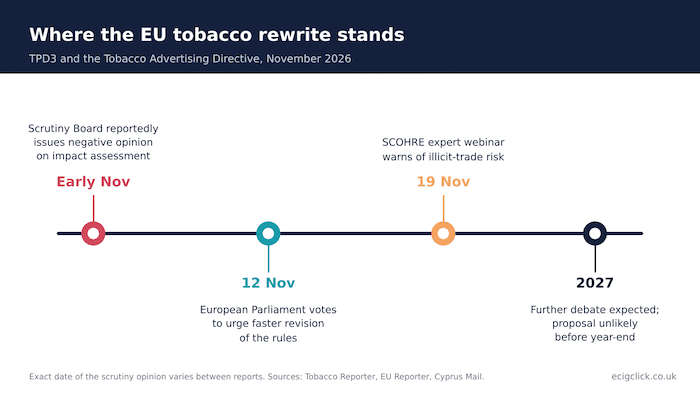
The warnings came during a November 19 webinar organized by the International Association on Smoking Control and Harm Reduction (SCOHRE), with subsequent coverage in the Cyprus Mail and Cyprus Business News on November 24.
The discussion focused on planned revisions to the Tobacco Products Directive (TPD3) and Tobacco Advertising Directive, which could significantly reshape Europe’s nicotine market.
Experts Warn Against Excessive Vape Restrictions
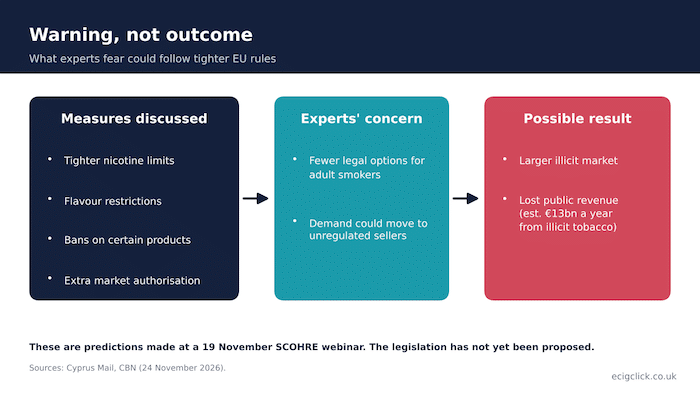
Clive Bates, former director of Action on Smoking and Health (ASH) UK, raised concerns about potential tighter nicotine limits, flavor restrictions, product bans, and additional market authorization requirements.
Bates argued that making alternatives to cigarettes less accessible could undermine tobacco harm reduction efforts while creating opportunities for illegal suppliers.
According to the webinar organizer’s published account, Bates said:
“If you’re precautionary about safer alternatives to smoking, you’re being reckless about smoking.”
Dr. Konstantinos Farsalinos also questioned whether European regulatory proposals adequately reflect the scientific evidence supporting vaping as a smoking cessation tool.
The latest Cochrane systematic review, published in August 2026, found high-certainty evidence that nicotine e-cigarettes were more effective at helping smokers quit than conventional nicotine replacement therapies.
Across 11 studies involving 4,114 participants, nicotine e-cigarettes increased quit rates by approximately 61% relative to nicotine replacement therapy, equivalent to around four additional successful quitters per 100 people.
Europe’s Vape Black Market Is Already Worth Billions
Perhaps the most concerning aspect of the debate is the sheer size of Europe’s existing unregulated vaping market.
A study published by Germany’s Fraunhofer Institute for Integrated Circuits and MRU GmbH in February 2026 estimated that, based on 2024 consumption:
- 52% of vaping products came from the regular market.
- 35% came from the commercial black market.
- 13% came from the gray market.
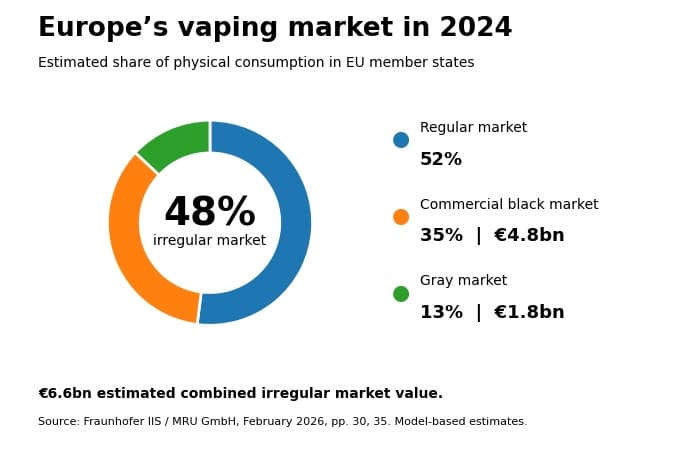 Researchers estimated the combined irregular market to be worth €6.6 billion, comprising €4.8 billion in commercial black-market activity and €1.8 billion in gray-market activity.
Under the study’s growth assumptions, that combined figure could reach €10.83 billion by 2030.
There are important caveats. The research was commissioned by Swiss consultancy SKR AG, and the figures are model-based estimates derived from consumer demand and official trade statistics, rather than recorded illegal sales.
The gray market also includes individuals obtaining non-compliant products for personal use, rather than commercial illegal trading.
Nevertheless, the findings suggest European authorities already face a substantial enforcement challenge.
Illegal tobacco presents another problem. A September 2026 report by the European Court of Auditors estimated that illicit tobacco costs the EU and its member states €13 billion in lost public revenue annually.
The Netherlands: Has the Vape Flavor Ban Worked?
The Netherlands provides an interesting case study for European lawmakers considering wider flavor restrictions.
Since January 2024, Dutch authorities have enforced a ban on vape flavors other than tobacco.
However, research published in Tobacco Control in August 2026 highlighted two studies finding that more than 80% of Dutch e-cigarette users continued to use non-permitted vaping products.
Researchers also found that 30% of newly notified vaping products in 2025 contained at least one prohibited flavoring ingredient, although notification does not necessarily mean those products reached retailers.
That doesn’t mean the ban has been entirely unsuccessful.
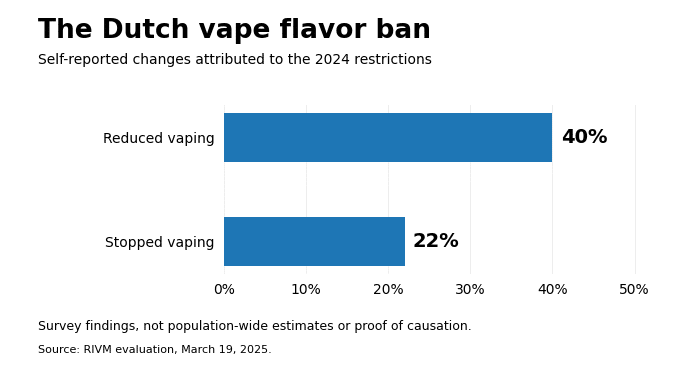
A Dutch National Institute for Public Health and the Environment (RIVM) evaluation found that 40% of respondents reported reducing their vaping because of the restrictions, while 22% reported stopping altogether.
 A subsequent peer-reviewed study published in April 2026 also found that smoking prevalence declined among the surveyed group of pre-ban vapers.
The Dutch experience illustrates the complexity of flavor restrictions. Some consumers may quit or reduce their nicotine use, while others continue using products that fall outside the permitted market.
Australia Offers Another Warning
Australia was another example raised during the webinar, and its experience makes for uncomfortable reading.
The country operates a pharmacy-only model for legal retail vape sales alongside some of the world’s highest tobacco taxes.
According to the Australian Illicit Tobacco and E-cigarette Commissioner’s 2024–25 report, an estimated 95.7% of the country’s e-cigarette market was illicit.
However, Australia’s situation isn’t entirely straightforward.
The Australian Institute of Health and Welfare reported that daily tobacco smoking fell to a record low of 5.6% among people aged 14 and over in 2025.
More recently, on November 15, the Australian government reported that its illegal tobacco market had contracted for the first time in years, following increased enforcement efforts.
Australia’s experience highlights the potential for substantial illicit markets to develop alongside declining smoking rates. It does not, however, establish that restrictive vaping regulations alone caused the black market.
EU Tobacco and Vape Reforms Face Further Delays
The timing of the experts’ warnings is significant.
As previously reported, the European Commission’s Regulatory Scrutiny Board has reportedly issued a second negative opinion on the impact assessment supporting the planned tobacco reforms.
According to Tobacco Reporter, the setback means publication of the legislative proposals before the end of 2026 is increasingly unlikely.
Meanwhile, on November 12, the European Parliament adopted a resolution calling for updated tobacco and nicotine legislation by 447 votes to 66, with 91 abstentions.
Potential measures include flavor restrictions, plain packaging, and stronger controls on nicotine products.
The resolution does not introduce these restrictions into law, and the final legislative proposals have yet to be published.
Could Tougher Regulations Make the Problem Worse?
Not everyone agrees with the argument put forward by tobacco harm reduction advocates.
In May 2026, a coalition of European medical and public health organizations, including the European Cancer Organisation and European Respiratory Society, argued that inadequate enforcement and governance, rather than high taxation, are the principal drivers of illicit tobacco trade.
Although their statement concerned the separate Tobacco Taxation Directive, it provides an important counterargument.
Similar challenges are already evident closer to home, where the UK’s illegal vape market could be worth £300 million annually.
Protecting young people from nicotine dependence is an important public health objective. But if European lawmakers introduce restrictions without adequately considering consumer behavior, smoking cessation, and enforcement capabilities, there is a risk that some demand will simply move elsewhere.
With Europe’s irregular vaping market already estimated to be worth billions, Brussels would be wise to examine that possibility carefully before deciding its next move.